
On this page
Where half-round gutters fit in Brentwood
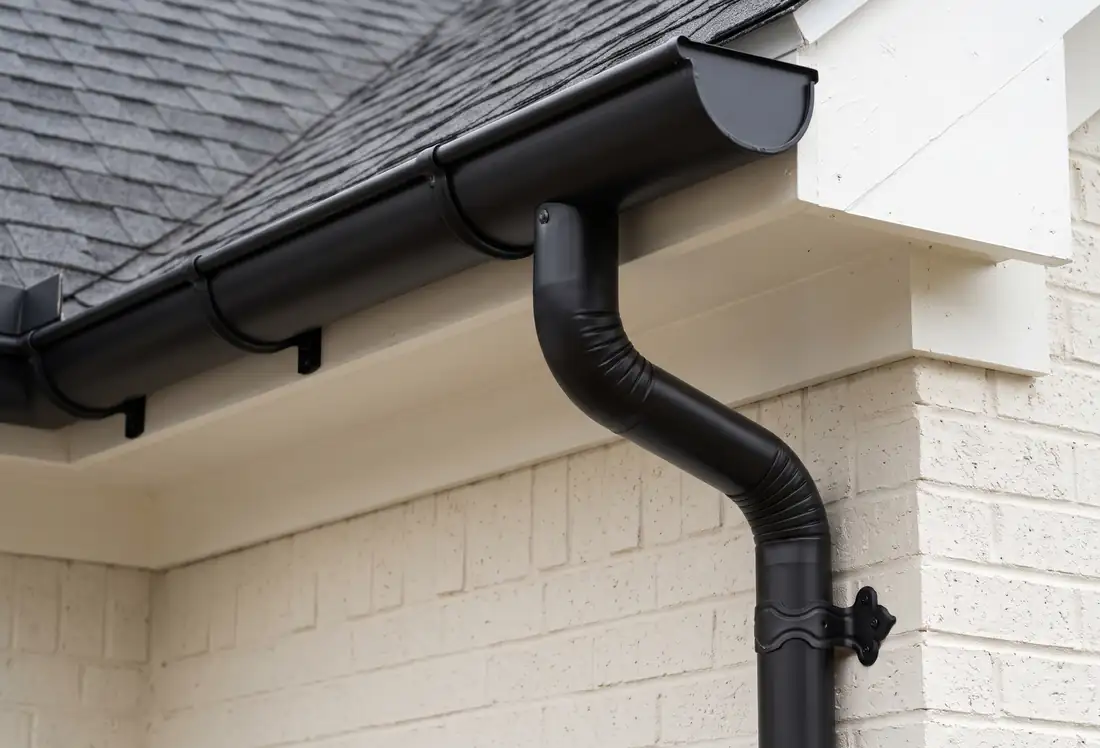
Half-round is the older gutter profile, and in Brentwood it shows up on two kinds of house.
Historic houses. Brentwood's antebellum homes are a small but important part of its housing. Ravenswood, built by James Hazard Wilson II between 1821 and 1825 and listed on the National Register in 1983, now stands in Smith Park. Mooreland on Franklin Road dates from about 1838, and the city's Historic Commission also looks after the Cool Springs House in Crockett Park and the Boiling Spring Academy in Primm Park. Houses like these usually call for half-round, often in copper, hung on brackets.
Traditional estates. Many of Brentwood's newer large homes borrow from the same tradition: Colonial and Georgian revival brick, Southern Colonial and French Country styles, tall rooflines and copper accents. Half-round gives them a softer line than K-style.
Half-round vs K-style
| Half-round | K-style | |
|---|---|---|
| Shape | Rounded trough with a rolled bead | Flat back and bottom, decorative ogee front |
| Look | Traditional, historic | Standard on most houses since the 1960s |
| Capacity | Slightly less, size for size | Slightly more |
| Downspouts | Round | Rectangular |
| Hangers | Exposed brackets or hidden hangers | Hidden hangers |
| Seamless | Usually sectional | Usually seamless |
| Materials | Copper, aluminum, steel | Mostly aluminum |
| Cleaning | Smooth bottom, easy to flush | Corners hold debris |
Sizes
| Roof | Half-round size | Downspouts |
|---|---|---|
| Small porch or dormer | 5-inch | 3-inch round |
| Main roof of a two-story house | 6-inch | 3 or 4-inch round |
| Large, steep main roof or long runs | 6-inch, sometimes 7 or 8-inch | 4-inch round |
Because half-round holds a little less than K-style, size up where in doubt. Brentwood's heavy spring rain is the test, and an undersized half-round shows it quickly.
Brackets and hangers
Half-round gutters hang on brackets that either fasten to the face of the fascia or strap to the roof deck under the shingles. Exposed brackets are part of the traditional look and come in copper, brass, steel and aluminum. Spacing matters: under big trees and where ice builds, closer spacing keeps the gutter from twisting. After the January 2026 ice storm, which left about 0.75 inches of ice in Brentwood, bent brackets were a common repair.
Materials
- Copper. The traditional choice on historic and estate houses. It weathers from bright to brown to green over the years and lasts for decades. Seams are soldered. See copper gutters.
- Aluminum. Much cheaper, light, does not rust, and comes in painted colors. A good option for traditional-style houses where copper is out of budget.
- Galvalume or galvanized steel. Stronger than aluminum, often used with a painted finish.
Working on a historic house
On an antebellum or early 20th-century house, the gutters are part of the building's character. Before changing them:
- Note what is there: profile, size, material, bracket type, downspout shape.
- Look for signs of an earlier built-in gutter in the cornice.
- Match the profile and material where you can.
- Avoid fastening into old millwork or brick with heavy hardware.
If a house is listed on the National Register or is a city-owned historic site, ask the owner or the Historic Commission before changing what is there.
Cost
Half-round costs more than K-style aluminum, mostly because it is sectional and takes more labor. Copper half-round costs several times as much as aluminum. See aluminum vs steel vs copper and what gutters cost in Brentwood.
Half-round on newer houses
Half-round is not only for old houses. Many newer Brentwood homes with Southern Colonial, French Country or English styling use half-round on the front and K-style elsewhere. The rounded profile looks softer, and exposed brackets in copper or black add detail. Aluminum half-round in dark bronze or black gives the look at a much lower price than copper.
Cleaning half-round
The smooth, rounded bottom of a half-round gutter flushes clean more easily than the flat-bottomed K-style, where debris settles in the corners. Under heavy tree cover, half-round still fills, and micro-mesh guards made for half-round are available.